
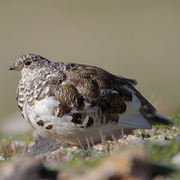


White-tailed Ptarmigan
General Description
The smallest grouse in North America, the White-tailed Ptarmigan is pure white in the winter, and streaked brown and gray during the summer. The tail remains white throughout the year. In Washington, this is the only species of grouse with white tail feathers.
Habitat
This species is found in remote, rocky, alpine areas at around 7,000 feet in Washington.
Behavior
These birds generally prefer walking over flight, perhaps as a means to conserve energy in their unforgiving habitat. Once pair bonds are formed, the male shadows the female constantly until she begins to incubate the eggs. These pair bonds can last up to 3 months within a season, which is atypical of the grouse family, and often the same pair bonds will reform the following year. During the fall and winter, they can be found in loose flocks, but are more territorial during the breeding season. They commonly make use of willows and the moist vegetation at the edge of snowfields. In winters with heavy snowfall, they will often move below the timberline.
Diet
Like most members of the family, the White-tailed Ptarmigan eats predominantly buds, leaves, and seeds. In the summer, this staple diet is supplemented with fruit, flowers, and insects. They are highly dependent on willow, especially in the winter. They have been known, like other members of this group, to swallow grit to help grind coarse food in their gizzards.
Nesting
The male guards the female while she selects a spot on the ground in a meadow or rocky area where she scrapes the ground and pulls vegetation around her in a rim. She keeps adding to this rim until she begins to incubate the eggs, at which point, the male ceases to guard her. Within 6-12 hours of hatching, the female leads her clutch of 4-8 chicks to food sources where they are able to feed themselves. They do not return to the nest.
Migration Status
White-tailed Ptarmigans are permanent residents, although they do tend to move to lower elevations where they can find vegetation to feed on during the winter. Even at these lower elevations, however, they remain above the snowline. Females move farther down slope than males, although both arrive in wintering areas in early-mid October. Males arrive on the breeding grounds in late April and females follow in mid-May.
Conservation Status
White-tailed Ptarmigans still occupy most of their historic range since much of that alpine habitat is fairly undisturbed. They generally live in areas that are open to the public and can potentially be negatively affected by a number of man-made influences, especially since the alpine zone is so slow to recover from disturbance.
When and Where to Find in Washington
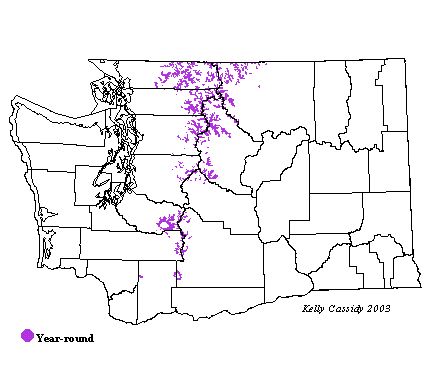
The White-tailed Ptarmigan is common in appropriate habitat in the Cascade Mountains. It is not found in the Olympic Mountains. This can be a very difficult bird to find, because much of the area that it inhabits is remote, it is cryptically colored, and it does not move when approached.
 Abundance
| Ecoregion | Jan | Feb | Mar | Apr | May | Jun | Jul | Aug | Sep | Oct | Nov | Dec |
|---|---|---|---|---|---|---|---|---|---|---|---|---|
| Oceanic | ||||||||||||
| Pacific Northwest Coast | ||||||||||||
| Puget Trough | ||||||||||||
| North Cascades | U | U | U | U | U | U | U | U | U | U | U | U |
| West Cascades | U | U | U | U | U | U | U | U | U | U | U | U |
| East Cascades | R | R | R | R | R | R | R | R | R | R | R | R |
| Okanogan | U | U | U | U | U | U | U | U | U | U | U | U |
| Canadian Rockies | ||||||||||||
| Blue Mountains | ||||||||||||
| Columbia Plateau |
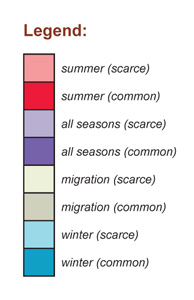
Washington Range Map
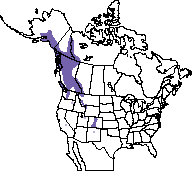
North American Range Map
Family Members
 ChukarAlectoris chukar
 Gray PartridgePerdix perdix
 Ring-necked PheasantPhasianus colchicus
 Ruffed GrouseBonasa umbellus
 Greater Sage-GrouseCentrocercus urophasianus
 Spruce GrouseFalcipennis canadensis
 White-tailed PtarmiganLagopus leucura
 Dusky GrouseDendragapus obscurus
 Sooty GrouseDendragapus fuliginosus
 Sharp-tailed GrouseTympanuchus phasianellus
 Wild TurkeyMeleagris gallopavo