
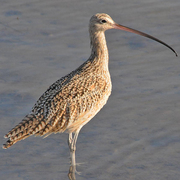


Long-billed Curlew

General Description
The Long-billed Curlew is the largest North American shorebird. It has a very long, decurved bill, which is longer on adult females than on males and juveniles. It is mottled brown overall, with cinnamon underwings. Sometimes a striped head pattern is evident, but it is far less pronounced than the head stripes on the Whimbrel. It is similar in size, shape, and color to the Marbled Godwit, but the curlew's decurved bill distinguishes it from the upturned bill of the Marbled Godwit.
Habitat
Dry grasslands and shrub savannahs are the traditional breeding habitats of Long-billed Curlews. They also nest in grain fields and pastures. During migration and winter, they can be found on coastal mudflats and marshes, and less commonly in fields and grasslands.
Behavior
These birds often gather in small flocks and forage by walking quickly along with their long bills extended forward, probing for food.
Diet
In summer, earthworms and other invertebrates are common prey. Berries may also be important food at certain times of the year. Birds in coastal areas eat crabs and other aquatic creatures.
Nesting
Males attract females and defend their territories with undulating flight displays, fluttering and gliding while calling. The nest is on the ground in the open, but is often located next to an object such a rock, a shrub, or even a pile of cow manure. The nest itself is a shallow scrape, usually sparsely lined with vegetation, sometimes with a rim built up around the edge. Both parents help incubate the four eggs for 27-30 days. The young leave the nest shortly after hatching and feed themselves, although both parents tend them and lead them to a marshy or damp area to find food. The young begin to fly at 32-45 days.
Migration Status
This short-distance migrant is one of the earliest breeding shorebirds, returning from wintering grounds from California to Mexico in mid-March, before their nesting grounds dry out. The adults leave by mid-July, with the young of the year leaving in mid-August.
Conservation Status
Once abundant, Long-billed Curlews declined as a result of hunting in the 1800s. Protection has helped the birds rebound, and now habitat destruction is their biggest threat. As more and more native grassland is converted to agriculture, the amount of potential Long-billed Curlew nesting habitat is shrinking. The Canadian Wildlife Service estimates the current population at about 20,000 birds.
When and Where to Find in Washington
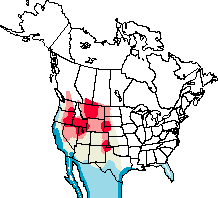
Long-billed Curlews breed in eastern Washington in the central Columbia Basin and up through the Okanogan Valley. They are uncommon throughout the state during migration. They generally winter south of Washington, but a flock winters around Tokeland at Willapa Bay (Pacific County) every winter. Bill's Spit at Ocean Shores is another place to look for them.
 Abundance
| Ecoregion | Jan | Feb | Mar | Apr | May | Jun | Jul | Aug | Sep | Oct | Nov | Dec |
|---|---|---|---|---|---|---|---|---|---|---|---|---|
| Oceanic | ||||||||||||
| Pacific Northwest Coast | U | U | U | R | R | U | U | U | U | U | U | |
| Puget Trough | ||||||||||||
| North Cascades | ||||||||||||
| West Cascades | ||||||||||||
| East Cascades | ||||||||||||
| Okanogan | R | U | U | U | U | |||||||
| Canadian Rockies | ||||||||||||
| Blue Mountains | ||||||||||||
| Columbia Plateau | U | U | U | U | U | R |
Washington Range Map

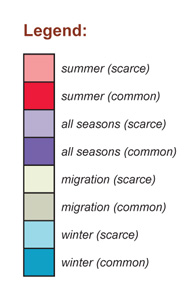
North American Range Map
Family Members
 Spotted SandpiperActitis macularius
 Solitary SandpiperTringa solitaria
 Gray-tailed TattlerTringa brevipes
 Wandering TattlerTringa incana
 Greater YellowlegsTringa melanoleuca
 WilletTringa semipalmata
 Lesser YellowlegsTringa flavipes
 Upland SandpiperBartramia longicauda
 Little CurlewNumenius minutus
 WhimbrelNumenius phaeopus
 Bristle-thighed CurlewNumenius tahitiensis
 Long-billed CurlewNumenius americanus
 Hudsonian GodwitLimosa haemastica
 Bar-tailed GodwitLimosa lapponica
 Marbled GodwitLimosa fedoa
 Ruddy TurnstoneArenaria interpres
 Black TurnstoneArenaria melanocephala
 SurfbirdAphriza virgata
 Great KnotCalidris tenuirostris
 Red KnotCalidris canutus
 SanderlingCalidris alba
 Semipalmated SandpiperCalidris pusilla
 Western SandpiperCalidris mauri
 Red-necked StintCalidris ruficollis
 Little StintCalidris minuta
 Temminck's StintCalidris temminckii
 Least SandpiperCalidris minutilla
 White-rumped SandpiperCalidris fuscicollis
 Baird's SandpiperCalidris bairdii
 Pectoral SandpiperCalidris melanotos
 Sharp-tailed SandpiperCalidris acuminata
 Rock SandpiperCalidris ptilocnemis
 DunlinCalidris alpina
 Curlew SandpiperCalidris ferruginea
 Stilt SandpiperCalidris himantopus
 Buff-breasted SandpiperTryngites subruficollis
 RuffPhilomachus pugnax
 Short-billed DowitcherLimnodromus griseus
 Long-billed DowitcherLimnodromus scolopaceus
 Jack SnipeLymnocryptes minimus
 Wilson's SnipeGallinago delicata
 Wilson's PhalaropePhalaropus tricolor
 Red-necked PhalaropePhalaropus lobatus
 Red PhalaropePhalaropus fulicarius