


Red Phalarope
General Description
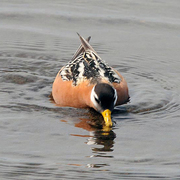
Female Red Phalaropes in breeding plumage have deep rufous necks, breasts, and bellies, and brown and black mottled backs. Their heads are black with white cheeks, and their bills are yellow. Males in breeding plumage look similar, but are duller, with a brown rather than a black cap. The adult in non-breeding plumage looks similar to a Red-necked Phalarope in non-breeding plumage, with white below and light gray above, a white head, and a black ear patch behind the eye. The Red-necked Phalarope's back is streaky gray, however, and the Red Phalarope's back is unstreaked. Juveniles have buff-colored underparts and heads. Their backs are black, edged in buff. The Red Phalarope's bill is much thicker than those of the other two species. The bill is yellow in breeding plumage, and dark with a lighter base in non-breeding plumage. The Red Phalarope has short legs and lobed toes. All adult plumages show a distinct white stripe down the wing and a dark stripe down the tail, with contrasting color on the sides of the rump. This species is also called the Gray Phalarope.
Habitat
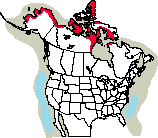
The Red Phalarope spends more time at sea than any of the other phalaropes. It nests in the low, wet tundra of the high Arctic coasts. Outside of breeding season, it is usually at sea, wintering in the waters off western South America and Africa, but also as far north as western North America. It is rarely found on fresh water, but when it is, these are typically small bodies of water, such as sewage ponds. Red Phalaropes usually occur farther offshore than Red-neckeds, but there may be an overlap. They can often be found in areas with upwellings or convergence zones that bring food to the surface.
Behavior
Red Phalaropes are usually in smaller flocks than Red-necked Phalaropes, but are sometimes in mixed flocks with them. They are often found with whales, and will pick parasites from their backs. These active birds generally feed by picking food from the water's surface, but will also strain plankton through their bills. When swimming, they occasionally spin in tight circles and create upwellings of food. They may land on seaweed mats at sea. When they are driven ashore by storms, they forage by walking slowly along the water's edge.
Diet
On their breeding grounds, Red Phalaropes eat a variety of invertebrates, especially insects, mollusks, and crustaceans. Their winter diet on the ocean is not well known, but includes small aquatic creatures.
Nesting
The female attracts a male with a display flight. Both sexes start scrapes, and the female picks one. The male adds a lining of grass, lichen, and moss to the shallow depression concealed in low vegetation near the water. After laying four eggs, the female leaves the male to provide all parental care. He incubates the eggs for 18-20 days and tends the brood once they hatch. The young leave the nest within a day of hatching and find their own food. The male may leave the young within a few days, or may stay with them until they can fly, at 16-18 days.
Migration Status
Red Phalaropes don't stage at interior lakes as do the other two phalaropes. They head for the ocean as soon as they have finished breeding. Most of the migration occurs offshore as well.
Conservation Status
The Canadian Wildlife Service estimates the global population of Red Phalaropes at 1,000,000 birds. This species is abundant on its breeding grounds, but is threatened by oil spills at sea and potential development of its breeding habitat.
When and Where to Find in Washington
A pelagic boat trip, especially during migration, is the best way to see Red Phalaropes. Red Phalaropes are the least common of the two ocean-going phalaropes, seen about half as often on boat trips as Red-necked Phalaropes. They can sometimes be seen from the coast, or even on shore in puddles and ponds, after a storm. They are late migrants, and commonly stay in the waters off Washington until December. Juveniles are very rarely reported in eastern Washington in the fall. Offshore, they can be seen in any month of the year, but are rare for much of that time. Spring migrants start coming through in the beginning of May, and are common by the second half of May. The spring migration is condensed, and birds are uncommon by the beginning of June. They become common again in mid-July, as adults start migrating south, and they remain common into mid-November, as the young of the year follow the adults. They are still present, but uncommon, until the end of November, after which they become rare again until spring.
 Abundance
| Ecoregion | Jan | Feb | Mar | Apr | May | Jun | Jul | Aug | Sep | Oct | Nov | Dec |
|---|---|---|---|---|---|---|---|---|---|---|---|---|
| Oceanic | U | U | R | U | U | U | U | R | R | |||
| Pacific Northwest Coast | R | R | R | U | U | R | R | U | U | U | R | R |
| Puget Trough | ||||||||||||
| North Cascades | ||||||||||||
| West Cascades | ||||||||||||
| East Cascades | ||||||||||||
| Okanogan | ||||||||||||
| Canadian Rockies | ||||||||||||
| Blue Mountains | ||||||||||||
| Columbia Plateau |
Washington Range Map

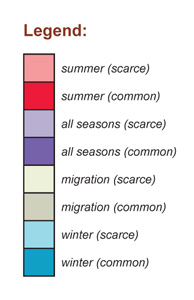
North American Range Map
Family Members
 Spotted SandpiperActitis macularius
 Solitary SandpiperTringa solitaria
 Gray-tailed TattlerTringa brevipes
 Wandering TattlerTringa incana
 Greater YellowlegsTringa melanoleuca
 WilletTringa semipalmata
 Lesser YellowlegsTringa flavipes
 Upland SandpiperBartramia longicauda
 Little CurlewNumenius minutus
 WhimbrelNumenius phaeopus
 Bristle-thighed CurlewNumenius tahitiensis
 Long-billed CurlewNumenius americanus
 Hudsonian GodwitLimosa haemastica
 Bar-tailed GodwitLimosa lapponica
 Marbled GodwitLimosa fedoa
 Ruddy TurnstoneArenaria interpres
 Black TurnstoneArenaria melanocephala
 SurfbirdAphriza virgata
 Great KnotCalidris tenuirostris
 Red KnotCalidris canutus
 SanderlingCalidris alba
 Semipalmated SandpiperCalidris pusilla
 Western SandpiperCalidris mauri
 Red-necked StintCalidris ruficollis
 Little StintCalidris minuta
 Temminck's StintCalidris temminckii
 Least SandpiperCalidris minutilla
 White-rumped SandpiperCalidris fuscicollis
 Baird's SandpiperCalidris bairdii
 Pectoral SandpiperCalidris melanotos
 Sharp-tailed SandpiperCalidris acuminata
 Rock SandpiperCalidris ptilocnemis
 DunlinCalidris alpina
 Curlew SandpiperCalidris ferruginea
 Stilt SandpiperCalidris himantopus
 Buff-breasted SandpiperTryngites subruficollis
 RuffPhilomachus pugnax
 Short-billed DowitcherLimnodromus griseus
 Long-billed DowitcherLimnodromus scolopaceus
 Jack SnipeLymnocryptes minimus
 Wilson's SnipeGallinago delicata
 Wilson's PhalaropePhalaropus tricolor
 Red-necked PhalaropePhalaropus lobatus
 Red PhalaropePhalaropus fulicarius