


Hover over to view. Click to enlarge.
American Redstart
General Description
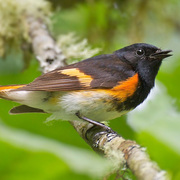
The American Redstart is a unique warbler. The male is black with orange patches on each wing, on the sides of its breast, and at the base of its tail on either side. The male's throat is black, but its breast and belly are white. The female is gray where the male is black, and yellow where the male is orange. The female also has a white eye-ring. Juveniles and first-year males look like females, although first-year males generally have some black on the upper breast or head. The American Redstart has a relatively short, wide bill.
Habitat
Throughout their range, American Redstarts are found in moist, second-growth hardwood forests, with a dense shrub layer. In Washington, they are typically confined to forested streamsides, especially those with willow and alder thickets. During the winter, American Redstarts inhabit a variety of tropical and subtropical lowland wooded habitats.
Behavior
American Redstarts are very active foragers. They glean some of their prey from foliage, but they capture most of their food in midair, flying or jumping into the air to snag prey. They commonly spread their tails and wings, displaying their orange or yellow spots. These flash-patterns may flush prey from the foliage, and also make American Redstarts relatively easy to find.
Diet
Small insects and other invertebrates make up most of the American Redstart's diet. In late summer, they may supplement this diet with berries and seeds.
Nesting
Monogamous pairs are the norm, but some males may have two or three mates at a time. The male shows the female potential nest sites during courtship, and the female makes the final selection. The nest is nestled against a trunk, or attached to vertical stems, from 4 to 70 feet off the ground. The female builds the nest, which is an open cup made of bark, grass, rootlets, and other plant fibers. The lining is usually made of feathers and hair. The outside may be camouflaged with lichen and birch bark, and the whole nest is held together with spider webbing. Sometimes American Redstarts will use old nests of other birds. The female typically incubates 4 eggs for 10 to 13 days. Both members of the pair feed the young. About 9 days after hatching, the young leave the nest, and the parents divide the brood, each taking half, and continue to feed them for at least a few more days.
Migration Status
Most American Redstarts migrate south through North America and winter in Mexico, Central America, and northern South America. Western breeders appear to migrate to western wintering areas, including southern California, Mexico, and Central America. They migrate at night, generally in the late spring and early fall.
Conservation Status
Although American Redstarts are still widespread and common throughout their range, they have experienced declines in many regions. Some of these declines may be from habitat loss due to natural maturation of forests, but others may be directly or indirectly related to habitat degradation from fragmentation. Fragmentation creates more edges, which initially attract more American Redstarts because of the increased brush in these areas. Later, however, predators and nest parasites are also attracted to edges, resulting in reduced productivity at forest edges. In a study in British Columbia, over 63% of American Redstart nests were parasitized by Brown-headed Cowbirds. In the West, many streamside forests have been eliminated or degraded, which may account for significant declines seen in western populations. Habitat destruction on the wintering grounds is also a conservation concern. In addition to natural forests, American Redstarts use shade-coffee plantations during the winter; supporting shade-grown coffee may help protect some of their winter habitat.
When and Where to Find in Washington
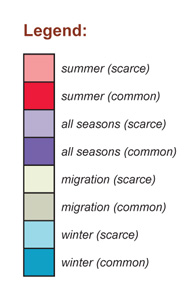
Although American Redstarts breed primarily in northeast Washington, there are a number of western Washington records. They are most common from mid-May to mid-August in the far northeastern corner of the state: eastern Okanogan, Ferry, Stevens, and Pend Oreille Counties. They are found (rarely) in a few spots on the east slope of the Cascades, and in southeastern Washington at the base of the Blue Mountains. Migrants, summer residents, and possibly some breeders are also found infrequently in northwestern Washington. Western Washington American Redstarts are most commonly seen along the Skagit River at the Skagit/Whatcom County line.
 Abundance
| Ecoregion | Jan | Feb | Mar | Apr | May | Jun | Jul | Aug | Sep | Oct | Nov | Dec |
|---|---|---|---|---|---|---|---|---|---|---|---|---|
| Oceanic | ||||||||||||
| Pacific Northwest Coast | ||||||||||||
| Puget Trough | ||||||||||||
| North Cascades | R | U | U | R | ||||||||
| West Cascades | ||||||||||||
| East Cascades | R | R | R | |||||||||
| Okanogan | R | R | R | R | ||||||||
| Canadian Rockies | F | F | F | U | R | |||||||
| Blue Mountains | ||||||||||||
| Columbia Plateau | R | R | R | R |
Washington Range Map

North American Range Map

Family Members
 Blue-winged WarblerVermivora pinus
 Golden-winged WarblerVermivora chrysoptera
 Tennessee WarblerVermivora peregrina
 Orange-crowned WarblerVermivora celata
 Nashville WarblerVermivora ruficapilla
 Northern ParulaParula americana
 Yellow WarblerDendroica petechia
 Chestnut-sided WarblerDendroica pensylvanica
 Magnolia WarblerDendroica magnolia
 Cape May WarblerDendroica tigrina
 Black-throated Blue WarblerDendroica caerulescens
 Yellow-rumped WarblerDendroica coronata
 Black-throated Gray WarblerDendroica nigrescens
 Black-throated Green WarblerDendroica virens
 Townsend's WarblerDendroica townsendi
 Hermit WarblerDendroica occidentalis
 Blackburnian WarblerDendroica fusca
 Yellow-throated WarblerDendroica dominica
 Prairie WarblerDendroica discolor
 Palm WarblerDendroica palmarum
 Bay-breasted WarblerDendroica castanea
 Blackpoll WarblerDendroica striata
 Black-and-white WarblerMniotilta varia
 American RedstartSetophaga ruticilla
 Prothonotary WarblerProtonotaria citrea
 OvenbirdSeiurus aurocapilla
 Northern WaterthrushSeiurus noveboracensis
 Kentucky WarblerOporornis formosus
 Mourning WarblerOporornis philadelphia
 MacGillivray's WarblerOporornis tolmiei
 Common YellowthroatGeothlypis trichas
 Hooded WarblerWilsonia citrina
 Wilson's WarblerWilsonia pusilla
 Yellow-breasted ChatIcteria virens