
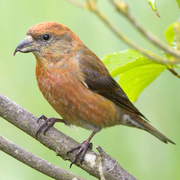


Red Crossbill
General Description
Red Crossbills are finches with highly specialized, crossed bills and long, pointed wings. Male Red Crossbills are brick-red with black wings and no white wing-bars. Females are greenish-yellow with black wings and no wing-bars. Juveniles are streaked brown. The bill size of Red Crossbills varies considerably and correlates with distinct habitat and food preferences as well as flight calls. These characteristics can be used to split Red Crossbills into eight distinct types, and it is likely that the species will be divided into multiple species in the future.
Habitat
Red Crossbills typically inhabit mature conifer forests, and the different types tend to specialize on preferred trees, including western hemlock, Ponderosa pine, lodgepole pine, Sitka, and Engleman spruce.
Behavior
Red Crossbills are usually found in small flocks year round. They typically climb in mature conifers, using their bills to grab branches and cones. They will also occasionally land on deciduous trees and forage for aphids. Their bills are adapted for removing seeds from cones, and they start at the bottom of a cone and spiral upward, prying open each scale and removing the seeds with their tongues. The bills can cross in either direction, and the direction of the cross dictates the direction that the bird spirals up the cone. Each type has a distinct flight call, which is helpful in identification and may play a role in maintaining the isolation of each group.
Diet
Conifer seeds make up the main diet of Red Crossbills. They also eat the buds of some trees, weed seeds, berries, and some insects, especially aphids.
Nesting
The breeding cycle of Red Crossbills is more closely tied to food availability than it is to season. They can breed at almost any time of year, and will do so even in mid-winter if there is an abundant source of seeds. They are monogamous, and pairs form within flocks. The female builds the nest, which is located on a horizontal branch high up in a conifer tree. The nest is a bulky cup of loose twigs, grass, and bark strips, lined with fine grass, lichen, feathers, and hair. The female typically incubates 3 eggs for 12 to 16 days. The male brings food to the incubating female and to the young for the first few days after they hatch. After five days of continuous brooding, the female joins the male in bringing food to the young. The young leave the nest after 18 to 22 days. The parents continue to feed the young for about a month after they hatch. The bills of young birds are not crossed at hatching, but cross as they grow. By 45 days they are crossed enough for the young to extract seeds from cones.
Migration Status
Red Crossbills are nomadic and congregate in areas with high levels of cone production. They often move into wooded lowlands in winter, but there is no consistent migration.
Conservation Status
Because Red Crossbills are nomadic in nature, the number of birds in any one place varies greatly from year to year, and it is hard to determine population status. Crossbills depend on mature trees for food, and logging practices that do not allow trees to reach cone-bearing age can be detrimental to the population. The species has a high reproductive potential, however, and can recover quickly from losses. At this time, they are currently widespread and common, but their requirement for mature trees is most likely the most significant threat they face.
When and Where to Find in Washington
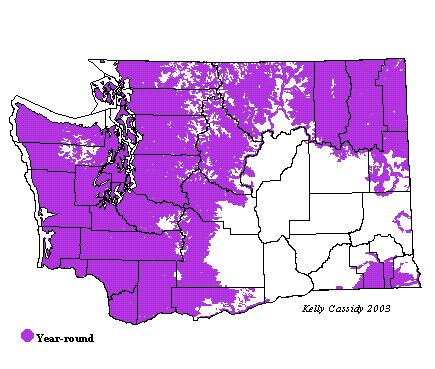
Because of their nomadic behavior, it is difficult to specify locations where Red Crossbills may be found. They can be abundant in Washington when there are good cone crops, and thousands of birds sometimes wander into the lowlands and coast from late summer through winter. However, their presence throughout Washington varies annually. Of the eight distinct types, six can be found in Washington. One form with a large and heavy bill breeds in Ponderosa, lodgepole, and shore pines throughout Washington. A small form with a small bill inhabits Sitka spruce and western hemlock on the Olympic Peninsula. A second type also specializes on western hemlock and can be found on the Olympic Peninsula. The third common form specializes on Douglas fir throughout the state. Two more types specialize in high-elevation lodgepole pine and Engleman spruce in the Cascades, Okanogan Highlands, and Blue Mountains.
 Abundance
| Ecoregion | Jan | Feb | Mar | Apr | May | Jun | Jul | Aug | Sep | Oct | Nov | Dec |
|---|---|---|---|---|---|---|---|---|---|---|---|---|
| Oceanic | ||||||||||||
| Pacific Northwest Coast | F | F | F | F | F | F | F | F | F | F | F | F |
| Puget Trough | F | F | F | F | F | F | F | F | F | F | F | F |
| North Cascades | F | F | F | F | F | F | F | F | F | F | F | F |
| West Cascades | F | F | F | F | F | F | F | F | F | F | F | F |
| East Cascades | F | F | F | F | F | F | F | F | F | F | F | F |
| Okanogan | C | C | C | C | C | C | C | C | C | C | C | C |
| Canadian Rockies | F | F | F | F | F | F | F | F | F | F | F | F |
| Blue Mountains | F | F | F | F | F | F | F | F | F | F | F | F |
| Columbia Plateau | U | U | U | U | U | U | U | U | U | U | U | U |
Washington Range Map
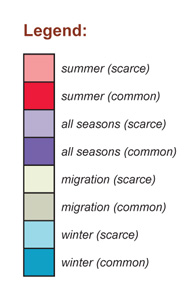
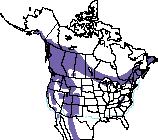
North American Range Map
Family Members
 BramblingFringilla montifringilla
 Gray-crowned Rosy-FinchLeucosticte tephrocotis
 Pine GrosbeakPinicola enucleator
 Purple FinchCarpodacus purpureus
 Cassin's FinchCarpodacus cassinii
 House FinchCarpodacus mexicanus
 Red CrossbillLoxia curvirostra
 White-winged CrossbillLoxia leucoptera
 Common RedpollCarduelis flammea
 Hoary RedpollCarduelis hornemanni
 Pine SiskinCarduelis pinus
 Lesser GoldfinchCarduelis psaltria
 American GoldfinchCarduelis tristis
 Evening GrosbeakCoccothraustes vespertinus