


American Black Duck
General Description
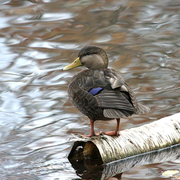
The American Black Duck is a large duck that closely resembles a female Mallard. The Black Duck's body color is darker than that of a Mallard, and the head color is slightly lighter. In flight, the Black Duck can be distinguished by the solid purplish-blue patch on its wing (lacking the white edges found on the Mallard) and the contrast between the dark body and upperwings and the light underwing linings. Black Ducks are unusual among dabbling ducks in that males and females are almost identical, distinguishable in the breeding season only by the bright yellow bill of the male.
Habitat
American Black Ducks are historically found in forested wetlands, tidewater areas, and coastal marshes of eastern North America.
Behavior
Black Ducks congregate in large groups in the fall and winter, when pair bonds form. Pairs remain together through the winter and into the breeding season. Once the eggs are laid and the female begins incubation, the pair dissolves. At this time the males molt their feathers and go through a month-long period of flightlessness while their new feathers grow in. Once the young fledge, the females go through the same flightless molt. By August, both sexes are able to fly again.
Diet
Black Ducks dabble for food, tipping their bodies up and dunking their heads to forage under water. They occasionally forage on land. When in coastal marshes, they are more omnivorous than most dabbling ducks, with mollusks, crustaceans, and arthropods making up nearly half of their diet. The other half is seeds, tubers, and other vegetable matter more typical of the group
Nesting
American Black Ducks nest on or near the ground, generally close to water. Dense clumps of vegetation help to obscure shallow depressions lined with plant material and feather down. The female incubates 9 to 10 eggs, rarely leaving the nest during the final few days before hatching. Immediately after hatching, chicks can swim and find food on their own.
Migration Status
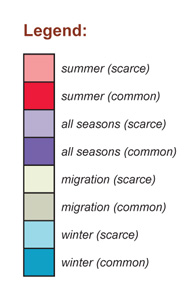
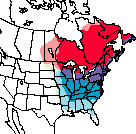
Black Ducks winter farther north and migrate later than most dabbling ducks. Throughout their range, they migrate varying distances, although the small population formerly in Washington was resident year round.
Conservation Status
A small, feral population was present in Washington from the late 1960s through the mid-1990s. This population appears to have been extirpated in recent years due to competition and hybridization with Mallards, a factor that also contributes to their decline in their traditional range. Since American Black Ducks are not native to Washington, this decline is not of major conservation concern in our state.
When and Where to Find in Washington
A few remnant birds may still be present near the Everett sewage ponds (Snohomish County), where the feral population once was. Vagrants also turn up occasionally in various locations. It is usually difficult to determine whether these birds are escapees from captive populations or true vagrants, wandering from their traditional range.
North American Range Map
Family Members
 Fulvous Whistling-DuckDendrocygna bicolor
 Taiga Bean-GooseAnser fabalis
 Greater White-fronted GooseAnser albifrons
 Emperor GooseChen canagica
 Snow GooseChen caerulescens
 Ross's GooseChen rossii
 BrantBranta bernicla
 Cackling GooseBranta hutchinsii
 Canada GooseBranta canadensis
 Mute SwanCygnus olor
 Trumpeter SwanCygnus buccinator
 Tundra SwanCygnus columbianus
 Wood DuckAix sponsa
 GadwallAnas strepera
 Falcated DuckAnas falcata
 Eurasian WigeonAnas penelope
 American WigeonAnas americana
 American Black DuckAnas rubripes
 MallardAnas platyrhynchos
 Blue-winged TealAnas discors
 Cinnamon TealAnas cyanoptera
 Northern ShovelerAnas clypeata
 Northern PintailAnas acuta
 GarganeyAnas querquedula
 Baikal TealAnas formosa
 Green-winged TealAnas crecca
 CanvasbackAythya valisineria
 RedheadAythya americana
 Ring-necked DuckAythya collaris
 Tufted DuckAythya fuligula
 Greater ScaupAythya marila
 Lesser ScaupAythya affinis
 Steller's EiderPolysticta stelleri
 King EiderSomateria spectabilis
 Common EiderSomateria mollissima
 Harlequin DuckHistrionicus histrionicus
 Surf ScoterMelanitta perspicillata
 White-winged ScoterMelanitta fusca
 Black ScoterMelanitta nigra
 Long-tailed DuckClangula hyemalis
 BuffleheadBucephala albeola
 Common GoldeneyeBucephala clangula
 Barrow's GoldeneyeBucephala islandica
 SmewMergellus albellus
 Hooded MerganserLophodytes cucullatus
 Common MerganserMergus merganser
 Red-breasted MerganserMergus serrator
 Ruddy DuckOxyura jamaicensis