
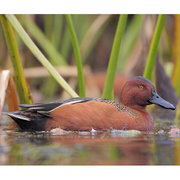


Cinnamon Teal
General Description
In many ways, the striking Cinnamon Teal is similar to the Blue-winged Teal and the Northern Shoveler, intermediate in size and overlapping habitat. The male Cinnamon Teal in breeding plumage is one of the most striking of Washington's waterfowl, with a deep, overall cinnamon color and red eyes. Females, juveniles, and males in eclipse plumage are mottled brown and look very similar to the closely related female Blue-winged Teal. However the Cinnamon Teal is slightly larger and has a longer, wider bill. Both sexes have green-black speculums with pale blue patches on the forewing.
Habitat
Cinnamon Teal are found in small, shallow, freshwater wetlands with emergent vegetation.
Behavior
Cinnamon Teal forage in shallow water, swimming forward with their heads partly submerged and filtering mud through their bills. These birds sometimes follow each other, taking advantage of food stirred up by the first bird. They occasionally feed on land near water. Cinnamon Teal, like most dabblers, form pairs before arriving on the breeding grounds.
Diet
Aquatic plant seeds and invertebrates make up the majority of the Cinnamon Teal's diet. The invertebrates become more important in the spring and summer, when breeding females and growing young need a high-protein diet.
Nesting
The nest is typically located close to water where it is concealed in dense cover. It is a shallow depression with dead grass and weeds, lined with down. The female selects the site, builds the nest, and incubates 9 to 10 eggs for 21 to 25 days without the help of the male. The male stays at the breeding area during most of the incubation, however, and may guard the female. Shortly after the young hatch, they leave the nest for the water and find their own food. The male Cinnamon Teal has occasionally been seen with the female and her young brood, an occurrence unusual in ducks. The female (occasionally with the help of the male) continues to tend the young until they fledge at about 7 weeks of age.
Migration Status
The Cinnamon Teal is highly migratory, beginning its fall migration early, peaking in August and September. It is rare on the breeding grounds by November. The spring migration begins in late March, but doesn't peak until late April into May. The molt migration for males, from the breeding grounds to the sites where they gather and molt, typically occurs in mid-July, before the birds head south again.
Conservation Status
The Cinnamon Teal is a western species and is the most common breeding teal in Washington. It is more limited in range than most North American dabbling ducks and as such, is one of the least abundant of this group, with an estimated population of about 300,000 birds. Its limited range and early fall migration protect it from high levels of hunting, and numbers appear to be stable. In the past century, however, humans have changed the landscape in such a way as to favor the Blue-winged Teal in some areas at the expense of the Cinnamon Teal. This may become a matter of concern if this trend continues.
When and Where to Find in Washington
Females, juveniles, and males in eclipse plumage (from July to September) can be difficult to distinguish from Blue-winged Teal, but Cinnamon Teal are the most common teal in most areas in Washington. They are much more common in eastern Washington, but can be found throughout the state in appropriate low-lying wetland habitat from early April to the end of September. They are extremely rare in these habitats the rest of the year.
 Abundance
| Ecoregion | Jan | Feb | Mar | Apr | May | Jun | Jul | Aug | Sep | Oct | Nov | Dec |
|---|---|---|---|---|---|---|---|---|---|---|---|---|
| Oceanic | ||||||||||||
| Pacific Northwest Coast | R | R | U | U | F | F | F | F | U | R | R | R |
| Puget Trough | R | R | R | F | F | F | F | F | U | R | R | R |
| North Cascades | U | U | U | U | U | |||||||
| West Cascades | F | F | F | F | U | |||||||
| East Cascades | U | U | U | R | R | U | U | |||||
| Okanogan | U | C | C | C | C | |||||||
| Canadian Rockies | F | F | F | F | F | |||||||
| Blue Mountains | U | U | U | U | R | |||||||
| Columbia Plateau | F | C | C | C | C | F | U | R |
Washington Range Map

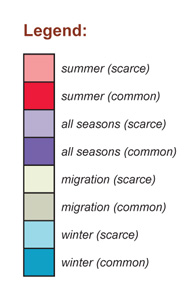
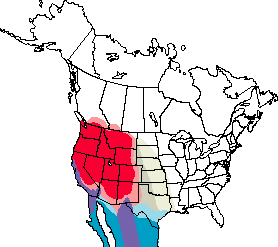
North American Range Map
Family Members
 Fulvous Whistling-DuckDendrocygna bicolor
 Taiga Bean-GooseAnser fabalis
 Greater White-fronted GooseAnser albifrons
 Emperor GooseChen canagica
 Snow GooseChen caerulescens
 Ross's GooseChen rossii
 BrantBranta bernicla
 Cackling GooseBranta hutchinsii
 Canada GooseBranta canadensis
 Mute SwanCygnus olor
 Trumpeter SwanCygnus buccinator
 Tundra SwanCygnus columbianus
 Wood DuckAix sponsa
 GadwallAnas strepera
 Falcated DuckAnas falcata
 Eurasian WigeonAnas penelope
 American WigeonAnas americana
 American Black DuckAnas rubripes
 MallardAnas platyrhynchos
 Blue-winged TealAnas discors
 Cinnamon TealAnas cyanoptera
 Northern ShovelerAnas clypeata
 Northern PintailAnas acuta
 GarganeyAnas querquedula
 Baikal TealAnas formosa
 Green-winged TealAnas crecca
 CanvasbackAythya valisineria
 RedheadAythya americana
 Ring-necked DuckAythya collaris
 Tufted DuckAythya fuligula
 Greater ScaupAythya marila
 Lesser ScaupAythya affinis
 Steller's EiderPolysticta stelleri
 King EiderSomateria spectabilis
 Common EiderSomateria mollissima
 Harlequin DuckHistrionicus histrionicus
 Surf ScoterMelanitta perspicillata
 White-winged ScoterMelanitta fusca
 Black ScoterMelanitta nigra
 Long-tailed DuckClangula hyemalis
 BuffleheadBucephala albeola
 Common GoldeneyeBucephala clangula
 Barrow's GoldeneyeBucephala islandica
 SmewMergellus albellus
 Hooded MerganserLophodytes cucullatus
 Common MerganserMergus merganser
 Red-breasted MerganserMergus serrator
 Ruddy DuckOxyura jamaicensis