


Canvasback

General Description
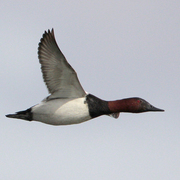
The Canvasback is a medium-sized duck with an elegant pattern of black, russet, and white. Males in breeding plumage have white-to-light-gray bodies, black undertail coverts and breasts, and deep rufous heads with red eyes. Adult males in non-breeding plumage have slightly darker bodies, but look similar. Female Canvasbacks are an overall grayish-brown in color, with a slightly browner head and neck. Juveniles look similar to females, but with less distinction between the head, neck, and body color. All ages and plumages have long, gently sloping black bills that give them a distinctive profile. This profile is one of the best ways to distinguish between the Canvasback and the similar-looking Redhead. Canvasbacks are also larger than Redheads, with long, flattish heads, and much whiter body coloration. Males can also be differentiated by their red eyes (male Redheads have yellow eyes) and bill color (black in Canvasbacks, blue with a black tip in Redheads).
Habitat
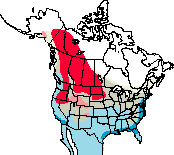
Canvasbacks breed in shallow prairie lakes and ponds with marshy shorelines, especially those with bulrush. They typically inhabit large lakes during migration. In winter they frequent sheltered lakes, saltwater bays, and estuaries. They also use sewage lagoons.
Behavior
In winter Canvasbacks gather in large flocks, often mixed with scaups. As divers, Canvasbacks usually find food under water but will also feed at the surface. Canvasbacks, like most other North American ducks, are seasonally monogamous. Most pairs form at stopover points during spring migration.
Diet
The bases and roots of aquatic plants, as well as some leaves and seeds, make up the majority of the Canvasback's diet. Wild celery is particularly favored. Mollusks, aquatic insects, and some small fish are also eaten, especially by nesting females and young.
Nesting
The nest, built by the female, is situated in dense emergent vegetation above shallow water, and sometimes on dry ground. It is a bulky bowl of vegetation lined with down. The female lays and incubates 8 to 10 eggs for 24 to 29 days. Several hours after the young hatch, the female leads them to open water where they feed themselves. They are tended by the female for several weeks. The male leaves during incubation, and the female leaves several weeks after the young hatch. The ducklings are left to fend for themselves until they can fly, at about 60 to 70 days.
Migration Status
Canvasbacks migrate late in fall and early in spring. Birds migrate in flocks, in a V-formation. Migration is relatively quick in the spring, but more drawn out in fall, lasting from late August to November.
Conservation Status
Although numbers vary considerably from year to year, the overall trend is one of long-term decline, mostly due to habitat loss. In fact, hunting seasons were closed in the Atlantic Flyway in the mid-1990s to allow recovery of very low population levels. In order to reverse this trend, the loss and degradation of wetlands needs to be arrested. The breeding range in Washington, which is at the southern edge of the North American breeding range, appears to be shrinking, and some areas that look like suitable habitat do not have nesting Canvasbacks. In these areas, Redheads may outcompete Canvasbacks.
When and Where to Find in Washington
Canvasbacks breed in eastern Washington at Potholes Reservoir and Winchester Wasteway (Grant County), at Turnbull National Wildlife Refuge (Spokane County), and in Okanogan County. Confirmed nesting records from the last ten years are limited to these three counties, although summer sightings of non-breeders may occur in appropriate habitat throughout the state. The Canvasback is a common migrant, appearing in late August at the earliest and becoming more common in October through November. In winter, Canvasbacks are found in lowlands west of the Cascades as well as in eastern Washington, although they are more common on salt water during the winter than on fresh water. They typically leave the wintering grounds in mid-April. Seward Park in Seattle is an excellent place to find wintering Canvasbacks.
 Abundance
| Ecoregion | Jan | Feb | Mar | Apr | May | Jun | Jul | Aug | Sep | Oct | Nov | Dec |
|---|---|---|---|---|---|---|---|---|---|---|---|---|
| Oceanic | ||||||||||||
| Pacific Northwest Coast | U | U | U | U | U | R | U | U | U | |||
| Puget Trough | F | F | U | U | R | R | U | C | F | |||
| North Cascades | ||||||||||||
| West Cascades | R | R | R | R | R | R | R | |||||
| East Cascades | U | U | U | U | R | R | U | U | U | U | ||
| Okanogan | R | R | C | U | U | U | U | U | U | C | U | R |
| Canadian Rockies | F | F | F | F | R | R | R | R | U | F | F | F |
| Blue Mountains | R | R | R | |||||||||
| Columbia Plateau | F | F | F | F | U | R | R | R | U | F | F | F |
Washington Range Map

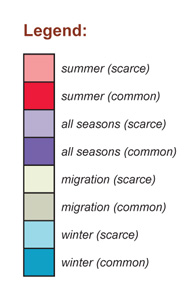
North American Range Map
Family Members
 Fulvous Whistling-DuckDendrocygna bicolor
 Taiga Bean-GooseAnser fabalis
 Greater White-fronted GooseAnser albifrons
 Emperor GooseChen canagica
 Snow GooseChen caerulescens
 Ross's GooseChen rossii
 BrantBranta bernicla
 Cackling GooseBranta hutchinsii
 Canada GooseBranta canadensis
 Mute SwanCygnus olor
 Trumpeter SwanCygnus buccinator
 Tundra SwanCygnus columbianus
 Wood DuckAix sponsa
 GadwallAnas strepera
 Falcated DuckAnas falcata
 Eurasian WigeonAnas penelope
 American WigeonAnas americana
 American Black DuckAnas rubripes
 MallardAnas platyrhynchos
 Blue-winged TealAnas discors
 Cinnamon TealAnas cyanoptera
 Northern ShovelerAnas clypeata
 Northern PintailAnas acuta
 GarganeyAnas querquedula
 Baikal TealAnas formosa
 Green-winged TealAnas crecca
 CanvasbackAythya valisineria
 RedheadAythya americana
 Ring-necked DuckAythya collaris
 Tufted DuckAythya fuligula
 Greater ScaupAythya marila
 Lesser ScaupAythya affinis
 Steller's EiderPolysticta stelleri
 King EiderSomateria spectabilis
 Common EiderSomateria mollissima
 Harlequin DuckHistrionicus histrionicus
 Surf ScoterMelanitta perspicillata
 White-winged ScoterMelanitta fusca
 Black ScoterMelanitta nigra
 Long-tailed DuckClangula hyemalis
 BuffleheadBucephala albeola
 Common GoldeneyeBucephala clangula
 Barrow's GoldeneyeBucephala islandica
 SmewMergellus albellus
 Hooded MerganserLophodytes cucullatus
 Common MerganserMergus merganser
 Red-breasted MerganserMergus serrator
 Ruddy DuckOxyura jamaicensis